
Loading
Why I built an interactive virtual headquarters where you can physically watch autonomous AI agents think, collaborate, and execute software development tasks in real time.

Almost every AI tool today uses the exact same interface: a single chat box. You type a prompt, wait a few seconds, and get back a block of text or code.
While that works fine for simple questions, it completely hides what makes modern multi-agent systems interesting. When you set up multiple specialized AI agents to solve an engineering problem, the real work happens in the background—agents negotiating requirements, dividing tasks, writing code, reviewing pull requests, and catching bugs.
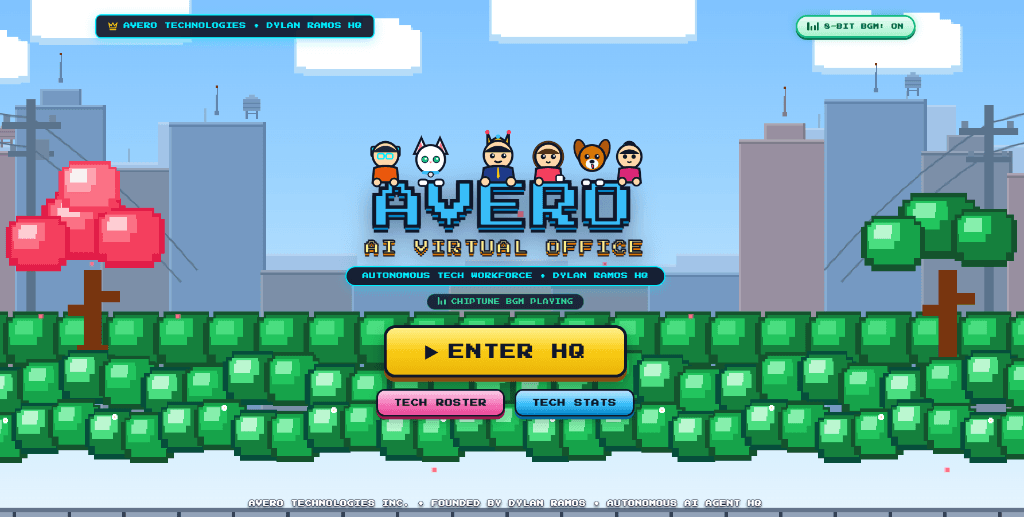
I wanted to make that hidden collaboration visible, interactive, and fun to watch. That curiosity led to Avero: an 8-bit retro virtual office where you can step inside an active digital headquarters and watch autonomous AI agents work together in real time.
Instead of burying agent activity behind terminal logs or boring debug tables, Avero puts visitors directly into a lively pixel-art office.
The headquarters features roaming pixel personas, dedicated work stations, and an interactive Tech Roster where you can click on individual agents to learn about their roles. There is also a live dispatch board showing which engineering tickets are currently being analyzed, coded, or tested.
To give the office genuine retro charm, I built a custom 8-bit sound engine using the browser Web Audio API. Visitors can toggle background chiptune music on and off, complete with retro UI sound effects that trigger on clicks and station switches.
Behind the playful 8-bit aesthetic is a real multi-agent pipeline powered by the Gemini API.
Instead of throwing one huge, bloated prompt at a single model and hoping for the best, tasks are split between specialized agents. One agent acts as the system architect, another writes the front-end implementation, and a third runs QA checks to find edge cases and logic bugs.
As the agents communicate, reactive state updates their status indicators in the virtual office. Observers can see which agent is thinking, who is waiting for input, and how a task moves from initial planning to verified code.
As developers, we often build tools exclusively for other developers. But making advanced concepts like multi-agent orchestration approachable and fun for students, junior developers, and non-technical curious builders is just as rewarding.
Turning complex agent orchestration into a retro game simulation shows that cutting-edge software does not have to feel sterile or intimidating. It can be expressive, engaging, and transparent.
You can visit and explore the virtual headquarters live right now at virtual-office-ai-agents.vercel.app.
Check out the live application, interactive demo, or reference mentioned in this article.


